
Groove Agent is a multitimbral plug-in that can load up to four kits and combine them. This combination is called a multi. This combination is called a multi. For example, multis allow you to play a drum style of an Acoustic Agent in combination with a percussion style of the Percussion Agent, triggering a single global pattern pad.
How to use Groove Agent SE to make great sounding beats in Cubase. Website: List: http://eepurl.com/bLwJ6fFacebo. In this episode I give a brief overview of the three different types of drum module within Groove Agent: Beat Agent, Acoustic Agent, and Percussion Agent. Groove Agent combines the creative power of three different rhythm modules: the Acoustic, Beat and Percussion Agents, which can be loaded in four slots. Each Agent can be combined with any of the others for layering and creating your own unique drum sound. Groove Agent SE combines the creative power of different rhythm modules: Acoustic Agent SE and Beat Agent SE. Each of these modules offers its own approach to drums and rhythms, with special ways of creating your own inspiring beats in a huge range of styles.
ConventionsIn our documentation, we use typographical and markup elements to structure information.
 How You Can Reach Us
Click the Steinberg logo in the top right corner of the control panel to open a pop-up menu containing items for getting additional information and help.
About the DocumentationThe documentation is available online and can be downloaded in PDF format from steinberg.help.
Setting UpYou can use Groove Agent as a plug-in in different host applications. Depending on the host application, you might have to make additional settings, or you might be restricted to a reduced parameter set, number of outputs, etc.
Dials and SlidersDials and sliders can be unidirectional or bidirectional. Unidirectional values, for example, level values, start at a minimum value and go up to the maximum. Bidirectional controls start from the middle position and go to the left for negative and to the right for positive values.
ButtonsGroove Agent contains two different types of buttons: On/Off buttons and push buttons.
Value FieldsYou can enter or edit values in the available value fields using your keyboard or mouse. To enter key ranges or the root key, for example, you can use an external MIDI keyboard.
PresetsGroove Agent offers two types of presets: section/module presets and VST presets. Section and module presets store and recall the setup of a specific component on the Groove Agent panel. VST presets contain all information necessary to restore the complete state of the plug-in.
These sections help you to get started with Groove Agent and introduce program functions and settings.
Window OverviewThe Groove Agent window is divided into several sections.
Agents, Kits, Multis, and Content FilesGroove Agent comes with a variety of content that can be loaded and edited. At the top of the hierarchy, you can load kits or multis. Further down the hierarchy, you can load and edit MIDI patterns, styles, drum samples, etc.
Loading a KitTo be able to hear a sound, you need to load a kit into Groove Agent.
Pattern and Instrument PadsIn Groove Agent, you can edit both the sounds and the patterns that are used by your drum tracks. Instrument sounds can be accessed via the instrument pads. The pattern or style that is played can be edited via the pattern pads.
Browsing for MIDI Patterns and StylesThe Load panel allows you to browse for patterns and styles and assign them to the pattern pads.
Playing back Pattern PadsYou can play back pattern pads using the MIDI Player or the Style Player. The MIDI player allows you to play and modify one pattern. The style player offers a variety of patterns, suited to create the different sections of your drum tracks.
Converting Styles to MIDI PatternsIf you have found an acoustic or a percussion style that you want to use on your pad, but want to edit it further in the Pattern editor, you must convert it to a MIDI pattern first.
Modifying MIDI Patterns in the Pattern EditorIn the Pattern editor, you can modify patterns by adding or deleting notes, by replacing a drum sound with another, etc.
Creating the Different Sections of a Drum TrackTo create the different sections of your drum track, for example, an intro, a fill, a main part, and an ending, it is useful to start by copying the current style to other pads. And then, to modify the style for those pads.
Recording Trigger Notes for Your PatternsWhen you use Groove Agent in a DAW project, you can record trigger notes at the positions where you want to trigger the patterns. This allows you to create the drums for your project on the fly, in the project context.
Dragging Patterns into a ProjectYou can drag patterns from Groove Agent into your DAW project and edit them there.
Editing Patterns in the DAWWhen you have created MIDI parts from your Groove Agent patterns, you can further edit the parts in the DAW.
Working with Multiple AgentsUsing multiple agents allows you to add drums of different styles to your drum track, for example, to add percussion to your acoustic drums.
Recording the MIDI OutputIf the host application supports MIDI output from plug-ins, you can record the MIDI output on a track in your DAW.
Groove Agent 5 Tutorial
Note RepeatNote Repeat allows you to repeat the notes of a particular drum sound.
DecomposeIf you are working with Beat Agent kits, you can use the Decompose function to split your samples into their noise and tonal components.
The following sections describe how to load, save, and manage the different kinds of sound files in Groove Agent.
Loading KitsYou need at least one kit to produce a sound with Groove Agent.
Kit SlotThis section shows the name of the loaded kit, allows you to load a different kit, and make basic settings such as specifying the polyphony for the kit, for example.
Kit RackThe kit rack to the right of the kit slot section gives you an overview over the loaded kits and their corresponding agent, and allows you to perform some editing for the selected kit via the context menu.
Managing and Loading FilesThe Load panel allows you to manage, navigate to, load, and preview different file types.
Groove Agent features two different types of pads: instrument pads and pattern pads. Instrument pads are used to trigger samples. Pattern pads trigger MIDI drum patterns or styles.
Pad SectionGroove Agent One
The pad section is located on the left in the plug-in window. It contains the transport controls, the group buttons, and the pads.
Renaming PadsRenaming pads is useful if the names of the samples or the MIDI files are either too long or not very intuitive. Furthermore, it allows you to indicate that more than one sample is mapped to a pad, for example.
Using Different MIDI Channels/Ports for Instrument Pads and Pattern PadsBy default, instrument and pattern pads share the same MIDI port. If instrument and pattern pads are both assigned and share the same trigger note, the pattern pad always gets priority, therefore, instrument pads that use the same trigger note as a pattern pad cannot be played via the same MIDI port. In this case, you have two options: You can set up a different MIDI port or a different MIDI channel for the pattern pads.
Pattern PadsPattern pads trigger MIDI drum patterns or styles.
Beat Agent is a full beat production instrument with all the tools and sounds to create amazing beats for any electronic or urban music genre.
Acoustic Agent is a next-generation virtual acoustic drummer that offers first-class drum sounds and an integrated player that creates the perfect accompaniment for your songs.
On the Edit page for instrument pads, you set up the sound of the kits.
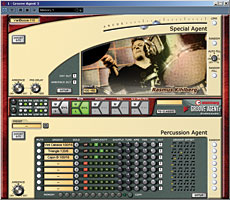
Percussion Agent specializes in instruments, grooves, and styles that feature percussive elements.
Acoustic Agent MixerThe Agent mixer for Acoustic Agent kits allows you to perform the mixing of these kits. Different content sets feature different sets of drum instruments, therefore, the available channel strips in the mixer vary with the kits.
Percussion Agent MixerThe Agent mixer contains a channel strip for each percussion instrument and its articulations.
 AUX Mixer
The AUX mixer features 4 AUX busses that can be used to realize classic send effects.
Groove Agent 5 Tutorials
Master MixerThe Master mixer shows the channel for the Master stereo output bus. It can host up to four insert effects that can be used to add a global EQ or compressor to the signal chain, for example.
AutomationYou can automate most of the Groove Agent parameters from within your host application, whether these are kit parameters or global parameters such as AUX effects.
MIDI ControllersYou can assign Groove Agent parameters to MIDI controllers.
Plug-in Functions SectionThe plug-in functions section at the top of the window gives you access to global functions that affect both the currently loaded programs, and the general working of the plug-in.
KeyboardYou can use the keyboard to get a better overview of the mapping and to trigger MIDI notes.
You can use Groove Agent independently from a host application.
Making Preferences SettingsYou can configure the standalone version of Groove Agent in the Plug-in Preferences dialog.
Preferences DialogThe Plug-in Preferences dialog has several pages on which you can make settings.
Scratch PadThe scratch pad allows you to record and play back MIDI files in Standard MIDI File format. You can load existing MIDI files and you can record your own files and save them.
Loading a MIDI FileYou can load MIDI files in Standard MIDI File format (file name extension .mid).
Groove Agent SE comes with a variety of content that can be loaded and edited. At the top of the hierarchy, you can load kits or VST presets. Further down the hierarchy, you can load and edit MIDI patterns, styles, drum samples, etc.
Agents
Groove Agent SE combines the creative power of different rhythm modules: Acoustic Agent SE and Beat Agent SE.
Each of these modules offers its own approach to drums and rhythms, with special ways of creating your own inspiring beats in a huge range of styles.
Kits
Kits are loaded to play the sounds in Groove Agent SE. They contain all information that is required to produce the sound of the selected drum kit, that is, about the sliced loop and the MIDI phrase that is needed to play back the loop, about the used MIDI patterns or styles, and about the insert effects that are used on the mixer channel.
You can save and load kits via the kit rack or the kit slot section.
Furthermore, kits contain information on the agent that the kit uses. In the Load dialog and on the Kits tab in the Load panel, kits are identified by the kit preset icon .
VST Presets
VST presets contain all Groove Agent SE settings, that is, all information necessary to restore the complete state of the plug-in. This includes the kit, the MIDI patterns or styles, as well as any insert and AUX effects. All of these settings are also saved with the project in your host application. You can load VST presets via the pop-up menu in the plug-in header.
Content Files and Folder Structure
Groove Agent SE comes with a large number of ready-to-use sound content files, containing kits, patterns, styles, and presets. Factory kits are write-protected. You can edit those files while they are loaded, but you cannot overwrite them.
To save your modifications to a factory kit, save the file under a new name. The file gets the file name extension .vstpreset and is saved with your user content. User content can be searched and categorized in the same way as factory content. User content is saved in a predefined folder structure on your hard disk. You can create subfolders within this structure to facilitate moving or exchanging content.
MIDI PatternsMIDI patterns contain information on notes and drum sounds and the rhythm in which they are played.
StylesStyles are complex structures of multiple patterns suited to create different parts of the drum tracks, for example, main pattern, fill, ending, and intro.
Groove Agent Se Download
You can manage your user MIDI patterns and styles, for example by adding new subfolders to the folder structure, by moving or removing MIDI files, etc. To access the folder where the user MIDI patterns or styles are saved, right-click the pattern or style, either in the Load panel or the Load dialog and select Show in Explorer/Finder. In this location, you can add, remove and rename files and create subfolders to organize your MIDI patterns.
Groove Agent One Download
Groove Agent ONE Content
Groove Agent SE can load Groove Agent ONE presets. The presets can either be loaded as kits in the kit rack or the kit slot section or as plug-in presets via the preset management menu in the plug-in header.
To load a Groove Agent ONE preset, drag it from the MediaBay of your Steinberg DAW onto a slot.
Groove Agent 5 Review
If you load a Groove Agent ONE preset as a plug-in preset, the global plug-in parameters are set to the default values.
If you load a preset as a kit, the global plug-in parameters remain unchanged.