
- Camel Hair Paintbrush Made Office
- Camel Hair Paintbrush Made Off
These free charts describe the different brush shapes and hair types, and Blick's system of standard brush sizing and measurement. |
|
|
|
DESCRIPTION AND USAGEFor blending oil paint on canvas, Badger Hair is an age-old tradtion. It comes from various parts of the world and is more readily available than most animal hair, although the quality varies greatly. Badger hair is thickest at the point, and relatively thin at the root, so it has a distinctive 'bushy' appearance. |
| |
DESCRIPTION AND USAGECamel Hair does not come from camels at all. It is found in watercolor and lettering brushes and usually is made of squirrel, goat, ox, pony or a blend of several hairs, depending on the desired softness and intended cost of the brush. |
| MEDIAlettering
tempera
watercolor |
|
DESCRIPTION AND USAGE Hog Bristle is obtained from hogs in several parts of the world, the most sought after coming from China. Bristle is unlike any other natural filler in that it forms a V-shaped split or 'flag' at the tip and tends to have a natural curve. A brush with 'interlocked' bristles, with the curves formed inward to the ferrule, has a natural resistance to fraying and spreads medium to thick paints smoothly and evenly. A selection of pure hog bristle brushes is recommended for oil and acrylic painting, and is a far less expensive alternative to good-quality softer hairs. |
| |
DESCRIPTION AND USAGE Kevrin/Mongoose Hair is strong, resilient, and makes a good long-wearing, medium to professional quality brush for oil and acrylic painting. |
| |
DESCRIPTION AND USAGE Kolinsky Sable is not really from a sable at all, but comes from the tail of a species of mink that is a member of the weasel family found in Siberia and northeastern China. It is generally conceded to be the best material for oil and watercolor brushes due to its strength, spring and ability to retain its shape ('snap'). It holds a very fine point or edge. This is considered a professional grade of hair, and if properly cared for, Kolinsky will last for many years. |
| |
DESCRIPTION AND USAGE The best quality comes from the ears of cattle or oxen. The Ox Hair has a very strong body with silken texture, is very resilient, has good 'snap', but lacks a fine tip. Therefore, it is most useful in medium gradewash brushes, or flat shaped brushes. Frequently, ox hair is blended with other natural hair to increase the resiliency of a brush. |
| MEDIAlettering
watercolor
|
|
DESCRIPTION AND USAGE Pony Hair is soft but strong, from mature animals at least 2 years of age. It is primarily used for scholastic grade brushes, but often blended with other hairs for inexpensive watercolor and touch-up brushes. |
| MEDIAacrylic
scholastic
tempera
watercolor
|
|
DESCRIPTION AND USAGE Red Sable is obtained from any member of the weasel family with 'red' hair, not at all from the animal known as the sable. It is found in a variety of brush styles for many varied mediums, with quality and characteristics varying greatly. A good quality pure Red Sable is a good alternative to the more expensive Kolinsky, with similar performance and durability. Often, weasel hair is blended with ox hair to make a more economical brush, but the fine point is sacrificed. |
| |
DESCRIPTION AND USAGE Sabeline is actually select, light-colored ox hair dyed to resembled red sable. Lettering and watercolor brushes often use Sabeline mixed with Sable to lower the cost of a brush. |
| MEDIAlettering
watercolor
|
|
DESCRIPTION AND USAGE Gray Squirrel (Talayoutky), most highly in demand for lettering brushes and quills, is native to Russia and nearly always fell in short supply. Brown squirrel (Kazan) is more readily available, and is used mainly for medium quality and scholastic watercolor brushes. A very fine, thin hair, taken from squirrel tails, it points as well as Kolinsky, but has very little 'snap' because the hair is not very resilient. It works best with liquid paints and inks. |
| MEDIAlettering
watercolor
|
|
DESCRIPTION AND USAGE Synthetics are man-made of either nylon or polyester filaments. They can be tapered, tipped, flagged, abraded or etched to increase color carrying ability. Often, synthetic filaments are dyed and baked to make them softer and more absorbent. The common name for this filament is 'Taklon'. Advantages of synthetic brushes are: 1) They are less prone to damage from solvents, insects or paints. 2) They are easier to keep clean than animal hair brushes because the filaments don't have animal scale structures to trap paint. 3) They are less prone to breakage and are durable on many different surfaces. 4) They are better suited for painting with acrylics because a synthetic filament will withstand the caustic nature of acrylic paints with less damage. |
| |
Camel hair brushes, used by artists, is a generic term for brushes that are made from all different types of hair such as goat, pony or sheep. BUT, the most common and most recognized, is squirrel. Camel Hair Brush, 1.91cm (3/4') W x 3.81cm (1-1/2') L each $5.10: Qty: Eyelash with Handle: enlarged view A carefully selected No. 1 Superfine eyelash is attached to a finely balanced wooden handle for delicate manipulation of ultra-thin sections in the knife boat of an ultramicrotome or wherever delicate teasing or manipulation is required. Soft hair brushes The best of these are made from kolinsky sable, other red sables, or miniver (Russian squirrel winter coat; tail) hair. Sabeline is ox hair dyed red to look like red sable and sometimes blended with it. Camel hair is a generic term for a cheaper and lower quality alternative, usually ox. It can be other species, or a blend of.
Paintbrush| Classification | Brush |
|---|
| Uses | Painting |
|---|
A paintbrush is a brush used to apply paint or sometimes ink. A paintbrush is usually made by clamping the bristles to a handle with a ferrule. They are available in various sizes, shapes, and materials. Thicker ones are used for filling in, and thinner ones are used for details. They may be subdivided into decorators' brushes used for painting and decorating and artists' brushes use for visual art.
Brush parts[edit]
- Bristles: Transfer paint onto the substrate surface
- Ferrule: Retains the bristles and attaches them to the handle
- Handle: The intended interface between the user and the tool
Trade painter's brushes[edit]
Brushes for use in non-artistic trade painting are geared to applying an even coat of paint to relatively large areas.
Following are the globally recognized handles of trade painter's brushes:
- Gourd Handle: Ergonomic design that reduces stress on the wrist and hand whilst painting.
- Short Handle: The shorter handle provides greater precision when painting small spaces such as corners, trims & detail areas.
- Flat Beavertail Handle: This shape is rounded and slightly flattened to fit perfectly into the palm of the hand whilst painting.
- Square Handle: Square shaped handle with bevelled corners is featured mainly in trim or sash brushes and is comfortable to hold when painting.
- Rat Tail Handle: This handle is longer & thinner than the standard making it easy to hold to give greater control.
- Long Handle: Rounded and thin, a long handle is easy to hold like a pencil giving great control & precision when cutting in & painting tricky spaces.[1]
Decorators' brushes[edit]
A paintbrush, with parts identified
Decorators' brushes
Using a paintbrush
The sizes of brushes used for painting and decorating.
Decorators' brush sizes[edit]
Decorators' brush sizes are given in millimeters (mm) or inches (in), which refers to the width of the head. Common sizes are:
- Metric: 10 mm, 20 mm, 40 mm, 50 mm, 60 mm, 70 mm, 80 mm, 90 mm, 100 mm.
- Customary: 1⁄8 in,1⁄4 in, 3⁄8 in, 1⁄2 in, 5⁄8 in, 3⁄4 in, 7⁄8 in, 1 in, 11⁄4 in, 11⁄2 in, 2 in, 21⁄2 in, 3 in, 31⁄2 in, 4 in.
Decorators' brush shapes[edit]
- Angled: For painting edges, bristle length viewed from the wide face of the brush uniformly decrease from one end of the brush to the other
- Flat: For painting flat surfaces, bristle length viewed from the wide face of the brush does not change
- Tapered: Improves control, the bristle length viewed from the narrow face of the brush is longer in the center and tapers toward the edges
- Striker: Large round (cylindrical) brush for exterior painting difficult areas
Decorators' brush bristles[edit]
Bristles may be natural or synthetic. If the filaments are synthetic, they may be made of polyester, nylon or a blend of nylon and polyester.Filaments can be hollow or solid and can be tapered or untapered. Brushes with tapered filaments give a smoother finish.
Synthetic filaments last longer than natural bristles. Natural bristles are preferred for oil-based paints and varnishes, while synthetic brushes are better for water-based paints as the bristles do not expand when wetted.
A decorator judges the quality of a brush based on several factors: filament retention, paint pickup, steadiness of paint release, brush marks, drag and precision painting. A chiseled brush permits the painter to cut into tighter corners and paint more precisely.
Brush handles may be made of wood or plastic while ferrules are metal (usually nickel-plated steel).
Artists' brushes[edit]
Short handled brushes are for watercolor or ink painting while the long handled brushes are for oil or acrylic paint.
Artist's brush shapes[edit]
The styles of brush tip seen most commonly are:


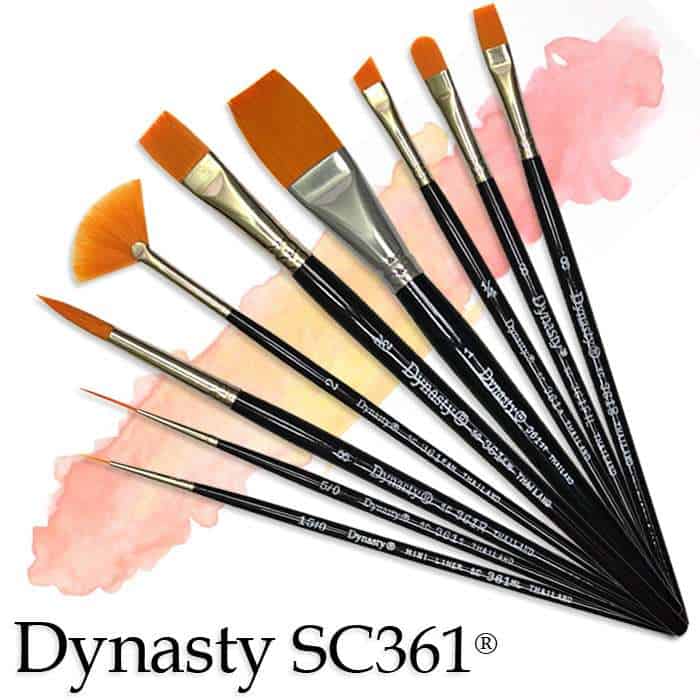
- Round: pointed tip, long closely arranged bristles for detail.
- Flat: for spreading paint quickly and evenly over a surface. They will have longer hairs than their Bright counterpart.
- Bright: shorter than flats. Flat brushes with short stiff bristles, good for driving paint into the weave of a canvas in thinner paint applications, as well as thicker painting styles like impasto work.
- Filbert: flat brushes with domed ends. They allow good coverage and the ability to perform some detail work.
- Fan: for blending broad areas of paint.
- Angle: like the filbert, these are versatile and can be applied in both general painting application as well as some detail work.
- Mop: a larger format brush with a rounded edge for broad soft paint application as well as for getting thinner glazes over existing drying layers of paint without damaging lower layers to protect the paintbrush
- Rigger: round brushes with longish hairs, traditionally used for painting the rigging in pictures of ships. They are useful for fine lines and are versatile for both oils and watercolors.
- Stippler and deer-foot stippler: short, stubby rounds
- Liner: elongated rounds
- Dagger looks like angle with longish hairs, used for one stroke painting like painting long leaves.
- Scripts: highly elongated rounds
- Egbert
Types of brushes
Brushes used in one stroke painting
Some other styles of brush include:
- Sumi: Similar in style to certain watercolor brushes, also with a generally thick wooden or metal handle and a broad soft hair brush that when wetted should form a fine tip. Also spelled Sumi-e (墨絵, Ink wash painting).
- Hake (刷毛): An Asian style of brush with a large broad wooden handle and an extremely fine soft hair used in counterpoint to traditional Sumi brushes for covering large areas. Often made of goat hair.
- Spotter: Round brushes with just a few short bristles. These brushes are commonly used in spotting photographic prints.
- Stencil: A round brush with a flat top used on stencils to ensure the bristles don't get underneath. Also used to create texture.
Artists' brush sizes[edit]
Artists' brushes are usually given numbered sizes, although there is no exact standard for their physical dimensions.
From smallest to largest, the sizes are:
- 20/0, 12/0, 10/0, 7/0, 6/0, 5/0, 4/0 (also written 0000), 000, 00, 0, 1, 2, 3, 4, 5, 6, 7, 8, 9, 10, 11, 12, 13, 14, 16, 18, 20, 22, 24, 25, 26, 28, 30. Brushes as fine as 30/0 are manufactured by major companies, but are not a common size.
Sizes 000 to 20 are most common.
Artists' brush bristles[edit]
Camel Hair Paintbrush Made Office
Closeup of an oil paintbrush
Types include:
Camel Hair Paintbrush Made Off
- watercolor brushes which are usually made of sable, synthetic sable or nylon;
- oil painting brushes which are usually made of sable or bristle;
- acrylic brushes which are almost entirely nylon or synthetic.
Turpentine or thinners used in oil painting can destroy some types of synthetic brushes. However, innovations in synthetic bristle technology have produced solvent resistant synthetic bristles suitable for use in all media. Natural hair, squirrel, badger or sable are used by watercolorists due to their superior ability to absorb and hold water.
Bristles may be natural—either soft hair or hog bristle—or synthetic.
- Soft hair brushes
- The best of these are made from kolinsky sable, other red sables, or miniver (Russian squirrel winter coat; tail) hair. Sabeline is ox hair dyed red to look like red sable and sometimes blended with it. Camel hair is a generic term for a cheaper and lower quality alternative, usually ox. It can be other species, or a blend of species, but never includes camel. Pony, goat, mongoose and badger are also used.
- Hog bristle
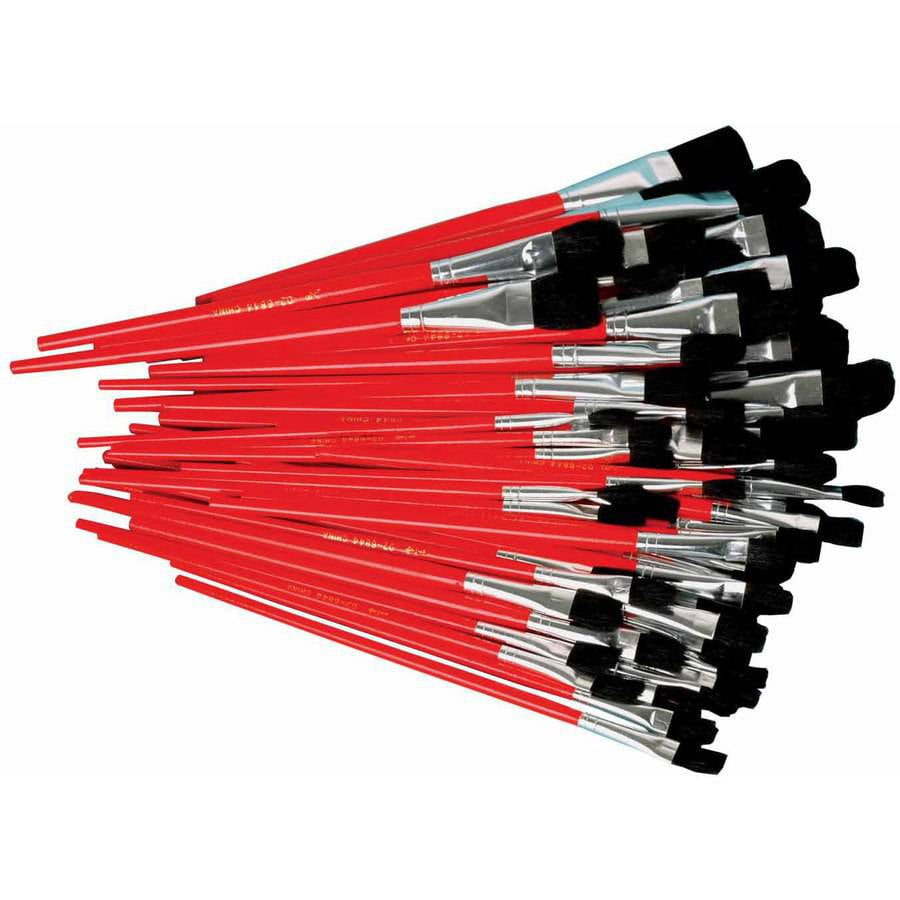
- Often called China bristle or Chungking bristle. This is stiffer and stronger than soft hair. It may be bleached or unbleached.
- Synthetic bristles
- These are made of special multi-diameter extruded nylon filament, Taklon or polyester. These are becoming ever more popular with the development of new water based paints.
Artists' brush handles[edit]
Artists' brush handles are commonly wooden but can also be made of molded plastic. Many mass-produced handles are made of unfinished raw wood; better quality handles are of seasoned hardwood. The wood is sealed and lacquered to give the handle a high-gloss, waterproof finish that reduces soiling and swelling.
Metal ferrules may be of aluminum, nickel, copper, or nickel-plated steel. Quill ferrules are also found: these give a different 'feel' to the brush, and are staple of French-style aquarel wash brushes.
References[edit]
- ^'Choose The Best Paint Brush | World's Finest Handcrafted Paint Brushes'. Monarch Painting | Australia's Finest Handcrafted Brushes, Rollers & Accessories. Retrieved 2019-02-24.
External links[edit]
| Wikimedia Commons has media related to paint brushes. |
| Look up paintbrush in Wiktionary, the free dictionary. |
Retrieved from 'https://en.wikipedia.org/w/index.php?title=Paintbrush&oldid=1017636879'