
-->
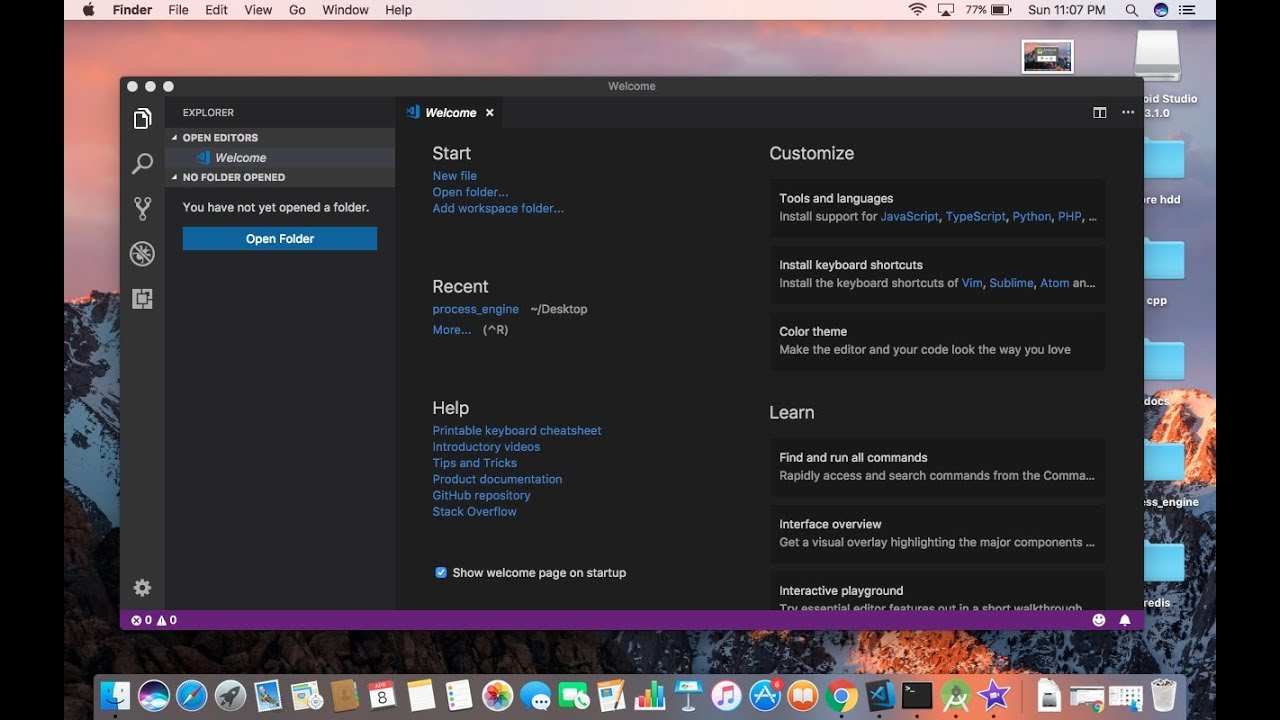
Get Code and Error Solutions: VS Code for Windows: Studio Code: https://code.visualstudio.co. Download Visual Studio Code 1.54.1 for Mac for free, without any viruses, from Uptodown. Try the latest version of Visual Studio Code 2021 for Mac.
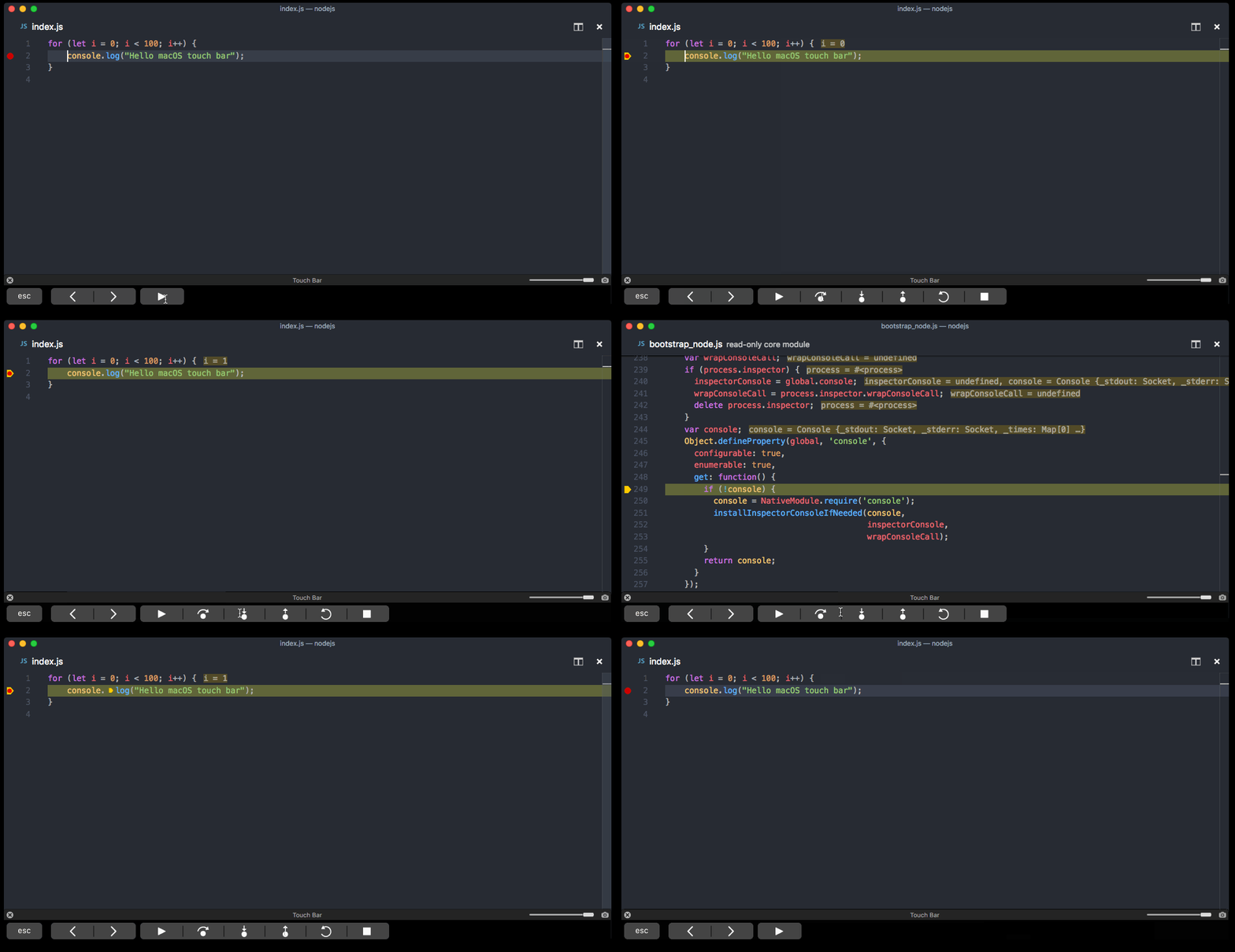
This tutorial introduces the debugging tools available in Visual Studio for Mac.
Prerequisites
- This tutorial works with the console app that you create in Create a .NET console application using Visual Studio for Mac.
Use Debug build configuration
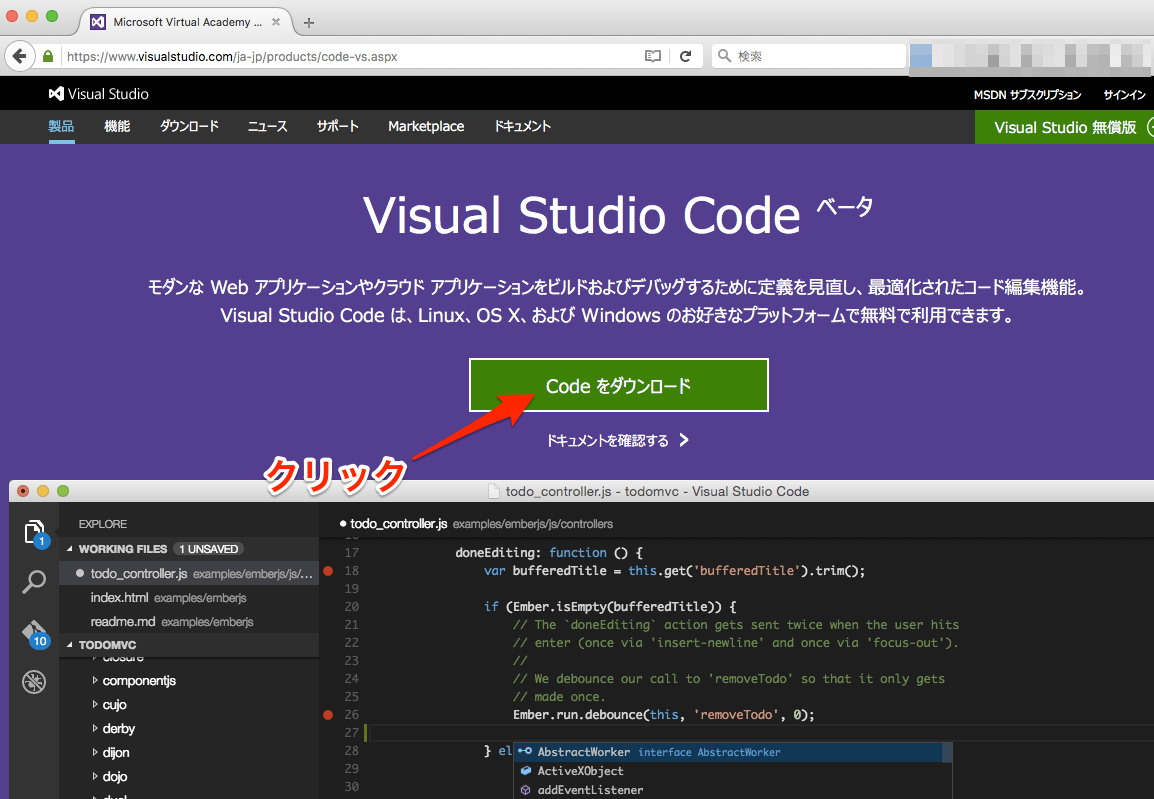
Debug and Release are Visual Studio's built-in build configurations. You use the Debug build configuration for debugging and the Release configuration for the final release distribution.
In the Debug configuration, a program compiles with full symbolic debug information and no optimization. Optimization complicates debugging, because the relationship between source code and generated instructions is more complex. The release configuration of a program has no symbolic debug information and is fully optimized.
By default, Visual Studio for Mac uses the Debug build configuration, so you don't need to change it before debugging.
Start Visual Studio for Mac.
Open the project that you created in Create a .NET console application using Visual Studio for Mac.
The current build configuration is shown on the toolbar. The following toolbar image shows that Visual Studio is configured to compile the Debug version of the app:
Set a breakpoint
A breakpoint temporarily interrupts the execution of the application before the line with the breakpoint is executed.
Set a breakpoint on the line that displays the name, date, and time. To do that, place the cursor in the line of code and press ⌘ (command+). Another way to set a breakpoint is by selecting Run > Toggle Breakpoint from the menu.
Visual Studio indicates the line on which the breakpoint is set by highlighting it and displaying a red dot in the left margin.
Press ⌘↵ (command+enter) to start the program in debugging mode. Another way to start debugging is by choosing Run > Start Debugging from the menu.
Enter a string in the terminal window when the program prompts for a name, and then press enter.
Program execution stops when it reaches the breakpoint, before the
Console.WriteLinemethod executes.
Use the Immediate window
The Immediate window lets you interact with the application you're debugging. You can interactively change the value of variables to see how it affects your program.
If the Immediate window is not visible, display it by choosing View > Debug Pads > Immediate.
Enter
name = 'Gracie'in the Immediate window and press enter.Enter
date = date.AddDays(1)in the Immediate window and press enter.The Immediate window displays the new value of the string variable and the properties of the DateTime value.
The Locals window displays the values of variables that are defined in the currently executing method. The values of the variables that you just changed are updated in the Locals window.
Press ⌘↵ (command+enter) to continue debugging.
The values displayed in the terminal correspond to the changes you made in the Immediate window.
If you don't see the Terminal, select Terminal - HelloWorld in the bottom navigation bar.
Press any key to exit the program.
Close the terminal window.
Set a conditional breakpoint
The program displays a string that the user enters. What happens if the user doesn't enter anything? You can test this with a useful debugging feature called a conditional breakpoint.
ctrl-click on the red dot that represents the breakpoint. In the context menu, select Edit Breakpoint.
In the Edit Breakpoint dialog, enter the following code in the field that follows And the following condition is true, and select Apply.
Each time the breakpoint is hit, the debugger calls the
String.IsNullOrEmpty(name)method, and it breaks on this line only if the method call returnstrue.Instead of a conditional expression, you can specify a hit count, which interrupts program execution before a statement is executed a specified number of times.
Press ⌘↵ (command+enter) to start debugging.
In the terminal window, press enter when prompted to enter your name.
Because the condition you specified (
nameis eithernullor String.Empty) has been satisfied, program execution stops when it reaches the breakpoint.Select the Locals window, which shows the values of variables that are local to the currently executing method. In this case,
Mainis the currently executing method. Observe that the value of thenamevariable is', that is, String.Empty.You can also see that the value is an empty string by entering the
namevariable name in the Immediate window and pressing enter.Press ⌘↵ (command+enter) to continue debugging.
In the terminal window, press any key to exit the program.
Close the terminal window.
Clear the breakpoint by clicking on the red dot in the left margin of the code window. Another way to clear a breakpoint is by choosing Run > Toggle Breakpoint while the line of code is selected.
Step through a program
Visual Studio also allows you to step line by line through a program and monitor its execution. Ordinarily, you'd set a breakpoint and follow program flow through a small part of your program code. Since this program is small, you can step through the entire program.
Set a breakpoint on the curly brace that marks the start of the
Mainmethod (press command+).Press ⌘↵ (command+enter) to start debugging.
Visual Studio stops on the line with the breakpoint.
Press ⇧⌘I (shift+command+I) or select Run > Step Into to advance one line.
Visual Studio highlights and displays an arrow beside the next line of execution.
At this point, the Locals window shows that the
argsarray is empty, andnameanddatehave default values. In addition, Visual Studio has opened a blank terminal.Press ⇧⌘I (shift+command+I).
Visual Studio highlights the statement that includes the
namevariable assignment. The Locals window shows thatnameisnull, and the terminal displays the string 'What is your name?'.Respond to the prompt by entering a string in the console window and pressing enter.
Press ⇧⌘I (shift+command+I).
Visual Studio highlights the statement that includes the
datevariable assignment. The Locals window shows the value returned by the call to the Console.ReadLine method. The terminal displays the string you entered at the prompt.Press ⇧⌘I (shift+command+I).
The Locals window shows the value of the
datevariable after the assignment from the DateTime.Now property. The terminal is unchanged.Press ⇧⌘I (shift+command+I).
Visual Studio calls the Console.WriteLine(String, Object, Object) method. The terminal displays the formatted string.
Press ⇧⌘U (shift+command+U) or select Run > Step Out.
The terminal displays a message and waits for you to press a key.
Press any key to exit the program.
Use Release build configuration
Once you've tested the Debug version of your application, you should also compile and test the Release version. The Release version incorporates compiler optimizations that can negatively affect the behavior of an application. For example, compiler optimizations that are designed to improve performance can create race conditions in multithreaded applications.
To build and test the Release version of the console application, do the following steps:
Change the build configuration on the toolbar from Debug to Release.
Press ⌥⌘↵ (option+command+enter) to run without debugging.
Next steps
In this tutorial, you used Visual Studio debugging tools. In the next tutorial, you publish a deployable version of the app.
In this tutorial you will learn how to install flutter with visual studio code in windows, mac & ubuntu.This tutorial mainly focuses on how to configure visual studio code with flutter.For installing flutter on windows, mac and Ubuntu just refer below links.
Windows:How to install flutter on windows with android studio.
Mac :How to install flutter on mac with Xcode.
Ubuntu :How to install flutter on ubuntu.
Installing Visual Studio Code
Windows
- Download Visual Studio Code.
- Once it is downloaded, run the installer (VSCodeUserSetup-{version}.exe). This will only take a minute.
Mac
Method 1
Installing visual studio code on mac is quite a simple task as this requires just one command to download and install.
To install visual studio code on mac just run the following command
Method 2
You can also install visual studio code the other way suggested in official documentation.lets see it below.
- Download Visual studio code for mac.
- Double-click on the downloaded archive to expand the contents.
- Drag Visual Studio Code.app to the Applications folder, making it available in the Launchpad.
- Add VS Code to your Dock by right-clicking on the icon to bring up the context menu and choosing Options, Keep in Dock.
Launching visual studio code from command line
You can also run VS Code from the terminal by typing ‘code’ after adding it to the path.
- Launch VS Code.
- Open the Command Palette (F1) and type ‘shell command’ to find the Shell Command: Install ‘code’ command in PATH command.
- Restart the terminal for the new $PATH value to take effect. You’ll be able to type ‘code .’ in any folder to start editing files in that folder.
Note: If you still have the old code alias in your .bash_profile (or equivalent) from an early VS Code version, remove it and replace it by executing the Shell Command: Install ‘code’ command in PATH command.
To manually add VS Code to your path, you can run the following commands
Start a new terminal to pick up your .bash_profile changes.
Note: The leading slash is required to prevent $PATH from expanding during the concatenation. Remove the leading slash if you want to run the export command directly in a terminal.
Ubuntu
Method 1
- To install visual studio code on Ubuntu download the 64 bit .deb file from the Visual Studio Download Page.
- Save the file on prompt and wait for the file to download.
- Once the file is downloaded go to downloads folder by using the following command.
- Now to install visual studio code run the following command.
- Replace your file name.deb in the above command with the name of the .deb package you downloaded
After replacing the above command will look like
That would install visual studio code successfully.
Method 2
We can also install visual studio code as per official documentation.Lets see the steps below.
Vs Code Download For Mac
The easiest way to install Visual Studio Code for Debian/Ubuntu based distributions is to download and install the .deb package (64-bit), either through the graphical software center if it’s available, or through the command line with
Installing the .deb package will automatically install the apt repository and signing key to enable auto-updating using the system’s package manager. Note that 32-bit and .tar.gz binaries are also available on the VS Code download page.
The repository and key can also be installed manually with the following script.
Then update the package cache and install the package using
Node Js Downloads
Install Flutter Extension on Visual Studio Code
- Launch Visual Studio code.
- Click on Extensions located in the left menu.
- Type flutter in the search bar.
- Find the flutter extension by dartcode.
- Click on install button
- Restart Visual Studio Code after installing the extension.
And you are done!!
That’s all about how to install flutter with visual studio code in windows, mac and Ubuntu.We will discuss other flutter concepts in next posts.
Install Vscode On Mac
Do like and share if you find the post helpful.Thank you!!
Visual Studio Code Mac Install Extension