
vignettes/dbplyr.Rmd- Tidyverse Cheat Sheet Pdf
- R Tidyverse Cheat Sheet
- R Dplyr Cheat Sheet
- Tidyverse Cheat Sheet Pdf
- R Data Wrangling Cheat Sheet
- Cheat Sheet Tidyverse
- R Tidyverse Cheat Sheet Pdf
Work with strings with stringr:: CHEAT SHEET Detect Matches strdetect(string, pattern) Detect the presence of a pattern match in a string. CC BY RStudio. info@rstudio.com. 844-448-1212. rstudio.com. Learn more at stringr.tidyverse.org. Diagrams from @LVaudor!. stringr 1.2.0. Updated: 2017-10. Tidyverse Cheat Sheet For Beginners November 30th, 2017 This tidyverse cheat sheet for beginners will help you to find your way around the well-known packages dplyr and ggplot2! Dplyr (and the tidyverse) Matthew Flickinger, Ph.D. CSG Tech Talk University of Michigan July 12, 2017. Tools to help to create tidy data, where each column is a variable, each row is an observation, and each cell contains a single value. Tidyr contains tools for changing the shape (pivoting) and hierarchy (nesting and unnesting) of a dataset, turning deeply nested lists into rectangular data frames (rectangling), and extracting values out of string columns. It also includes tools for working. For a history of factors, I recommend stringsAsFactors: An unauthorized biography by Roger Peng and stringsAsFactors = by Thomas Lumley. If you want to learn more about other approaches to working with factors and categorical data, I recommend Wrangling categorical data in R, by Amelia McNamara and Nicholas Horton.
As well as working with local in-memory data stored in data frames, dplyr also works with remote on-disk data stored in databases. This is particularly useful in two scenarios:
Your data is already in a database.
You have so much data that it does not all fit into memory simultaneously and you need to use some external storage engine.
(If your data fits in memory there is no advantage to putting it in a database: it will only be slower and more frustrating.)
This vignette focuses on the first scenario because it’s the most common. If you’re using R to do data analysis inside a company, most of the data you need probably already lives in a database (it’s just a matter of figuring out which one!). However, you will learn how to load data in to a local database in order to demonstrate dplyr’s database tools. At the end, I’ll also give you a few pointers if you do need to set up your own database.
Getting started

To use databases with dplyr you need to first install dbplyr:
You’ll also need to install a DBI backend package. The DBI package provides a common interface that allows dplyr to work with many different databases using the same code. DBI is automatically installed with dbplyr, but you need to install a specific backend for the database that you want to connect to.
Five commonly used backends are:
RMariaDB connects to MySQL and MariaDB
RPostgres connects to Postgres and Redshift.
RSQLite embeds a SQLite database.
odbc connects to many commercial databases via the open database connectivity protocol.
bigrquery connects to Google’s BigQuery.
If the database you need to connect to is not listed here, you’ll need to do some investigation (i.e. googling) yourself.
In this vignette, we’re going to use the RSQLite backend which is automatically installed when you install dbplyr. SQLite is a great way to get started with databases because it’s completely embedded inside an R package. Unlike most other systems, you don’t need to setup a separate database server. SQLite is great for demos, but is surprisingly powerful, and with a little practice you can use it to easily work with many gigabytes of data.
Connecting to the database
To work with a database in dplyr, you must first connect to it, using DBI::dbConnect(). We’re not going to go into the details of the DBI package here, but it’s the foundation upon which dbplyr is built. You’ll need to learn more about if you need to do things to the database that are beyond the scope of dplyr.
The arguments to DBI::dbConnect() vary from database to database, but the first argument is always the database backend. It’s RSQLite::SQLite() for RSQLite, RMariaDB::MariaDB() for RMariaDB, RPostgres::Postgres() for RPostgres, odbc::odbc() for odbc, and bigrquery::bigquery() for BigQuery. SQLite only needs one other argument: the path to the database. Here we use the special string ':memory:' which causes SQLite to make a temporary in-memory database.
Most existing databases don’t live in a file, but instead live on another server. That means in real-life that your code will look more like this:
(If you’re not using RStudio, you’ll need some other way to securely retrieve your password. You should never record it in your analysis scripts or type it into the console. Securing Credentials provides some best practices.)
Our temporary database has no data in it, so we’ll start by copying over nycflights13::flights using the convenient copy_to() function. This is a quick and dirty way of getting data into a database and is useful primarily for demos and other small jobs.
As you can see, the copy_to() operation has an additional argument that allows you to supply indexes for the table. Here we set up indexes that will allow us to quickly process the data by day, carrier, plane, and destination. Creating the right indices is key to good database performance, but is unfortunately beyond the scope of this article.
Now that we’ve copied the data, we can use tbl() to take a reference to it:
When you print it out, you’ll notice that it mostly looks like a regular tibble:
The main difference is that you can see that it’s a remote source in a SQLite database.
Generating queries
To interact with a database you usually use SQL, the Structured Query Language. SQL is over 40 years old, and is used by pretty much every database in existence. The goal of dbplyr is to automatically generate SQL for you so that you’re not forced to use it. However, SQL is a very large language and dbplyr doesn’t do everything. It focusses on SELECT statements, the SQL you write most often as an analyst.
Most of the time you don’t need to know anything about SQL, and you can continue to use the dplyr verbs that you’re already familiar with:
However, in the long-run, I highly recommend you at least learn the basics of SQL. It’s a valuable skill for any data scientist, and it will help you debug problems if you run into problems with dplyr’s automatic translation. If you’re completely new to SQL you might start with this codeacademy tutorial. If you have some familiarity with SQL and you’d like to learn more, I found how indexes work in SQLite and 10 easy steps to a complete understanding of SQL to be particularly helpful.
The most important difference between ordinary data frames and remote database queries is that your R code is translated into SQL and executed in the database on the remote server, not in R on your local machine. When working with databases, dplyr tries to be as lazy as possible:
It never pulls data into R unless you explicitly ask for it.
Eifert datensysteme driver. It delays doing any work until the last possible moment: it collects together everything you want to do and then sends it to the database in one step.
For example, take the following code:

Surprisingly, this sequence of operations never touches the database. It’s not until you ask for the data (e.g. by printing tailnum_delay) that dplyr generates the SQL and requests the results from the database. Even then it tries to do as little work as possible and only pulls down a few rows.
Behind the scenes, dplyr is translating your R code into SQL. You can see the SQL it’s generating with show_query():
If you’re familiar with SQL, this probably isn’t exactly what you’d write by hand, but it does the job. You can learn more about the SQL translation in vignette('translation-verb') and vignette('translation-function').
Typically, you’ll iterate a few times before you figure out what data you need from the database. Once you’ve figured it out, use collect() to pull all the data down into a local tibble:
collect() requires that database does some work, so it may take a long time to complete. Otherwise, dplyr tries to prevent you from accidentally performing expensive query operations:
Because there’s generally no way to determine how many rows a query will return unless you actually run it,
nrow()is alwaysNA.Because you can’t find the last few rows without executing the whole query, you can’t use
tail().
You can also ask the database how it plans to execute the query with explain(). The output is database dependent, and can be esoteric, but learning a bit about it can be very useful because it helps you understand if the database can execute the query efficiently, or if you need to create new indices.
Creating your own database
If you don’t already have a database, here’s some advice from my experiences setting up and running all of them. SQLite is by far the easiest to get started with. Download emerald laptops & desktops driver. PostgreSQL is not too much harder to use and has a wide range of built-in functions. In my opinion, you shouldn’t bother with MySQL/MariaDB: it’s a pain to set up, the documentation is subpar, and it’s less featureful than Postgres. Google BigQuery might be a good fit if you have very large data, or if you’re willing to pay (a small amount of) money to someone who’ll look after your database.
All of these databases follow a client-server model - a computer that connects to the database and the computer that is running the database (the two may be one and the same but usually isn’t). Getting one of these databases up and running is beyond the scope of this article, but there are plenty of tutorials available on the web.
MySQL/MariaDB
In terms of functionality, MySQL lies somewhere between SQLite and PostgreSQL. It provides a wider range of built-in functions. It gained support for window functions in 2018.
PostgreSQL
PostgreSQL is a considerably more powerful database than SQLite. It has a much wider range of built-in functions, and is generally a more featureful database.
BigQuery
BigQuery is a hosted database server provided by Google. To connect, you need to provide your project, dataset and optionally a project for billing (if billing for project isn’t enabled).
It provides a similar set of functions to Postgres and is designed specifically for analytic workflows. Because it’s a hosted solution, there’s no setup involved, but if you have a lot of data, getting it to Google can be an ordeal (especially because upload support from R is not great currently). (If you have lots of data, you can ship hard drives!)
Tidyverse cheat sheet
RStudio Cheatsheets, This cheatsheet reminds you how to make factors, reorder their levels, recode their evaluation in R that makes it easier to program with tidyverse functions. The tidyverse cheat sheet will guide you through some general information on the tidyverse, and then covers topics such as useful functions, loading in your data, manipulating it with dplyr and lastly, visualize it with ggplot2. In short, everything that you need to kickstart your data science learning with R! Do you want to learn more?
[PDF] Data Wrangling Cheat Sheet, Data Wrangling with dplyr and tidyr. Cheat Sheet. RStudio® is a trademark of RStudio, Inc. • CC BY RStudio • info@rstudio.com • 844-448-1212 • rstudio.com. R For Data Science Cheat Sheet Tidyverse for Beginners Learn More R for Data Science Interactively at www.datacamp.com Tidyverse DataCamp Learn R for Data Science Interactively The tidyverse is a powerful collection of R packages that are actually data tools for transforming and visualizing data. All packages of the
Tidyverse Cheat Sheet For Beginners, This tidyverse cheat sheet will guide you through the basics of the tidyverse, and 2 of its core packages: dplyr and ggplot2! The Data Import cheatsheet reminds you how to read in flat files with http://readr.tidyverse.org/, work with the results as tibbles, and reshape messy data with tidyr. Use tidyr to reshape your tables into tidy data, the data format that works the most seamlessly with R and the tidyverse. Updated January 17. Download
Purrr : : CHEAT SHEET
Drivers ducttapedgoat usb devices. Apply functions with purrr : : CHEAT SHEET Modify function behavior rstudio.com • 844-448-1212 • rstudio.com • Learn more at purrr.tidyverse.org • purrr
Analytics cookies. We use analytics cookies to understand how you use our websites so we can make them better, e.g. they're used to gather information about the pages you visit and how many clicks you need to accomplish a task.
The purrr package makes it easy to work with lists and functions. This cheatsheet will remind you how to manipulate lists with purrr as well as how to apply functions iteratively to each element of a list or vector. The back of the cheatsheet explains how to work with list-columns.
Dplyr
A Grammar of Data Manipulation • dplyr, All of the dplyr functions take a data frame (or tibble) as the first argument. Rather than forcing the user to either save intermediate objects or nest functions, dplyr On-demand. Online. Learn data science at your own pace by coding online.
Tidyverse Cheat Sheet Pdf
Introduction to dplyr, dplyr: A Grammar of Data Manipulation. A fast, consistent tool for working with data frame like objects, both in memory and out of memory. dplyr is a grammar of data manipulation, providing a consistent set of verbs that help you solve the most common data manipulation challenges: mutate () adds new variables that are functions of existing variables select () picks variables based on their names. filter () picks cases based on their values.
CRAN, Overview. dplyr is a grammar of data manipulation, providing a consistent set of verbs that help you solve the most common data manipulation challenges:. dplyr is a grammar of data manipulation, providing a consistent set of verbs that help you solve the most common data manipulation challenges: mutate () adds new variables that are functions of existing variables select () picks variables based on their names. filter () picks cases based on their values.
Tidyverse PDF
[PDF] Package 'tidyverse', Package 'tidyverse'. November 21, 2019. Title Easily Install and Load the 'Tidyverse'. Version 1.3.0. Description The 'tidyverse' is a set of packages that work in. Learn exploratory data analysis with R by watching videos and by coding.
[PDF] An Introduction to Tidyverse, Download this PDF from my website at joeystanley.com/r. An Introduction to Tidyverse by Joseph A. Stanley is licensed under a. Creative tidyverse include dplyr, tidyr, and ggplot2, which are among the most popular R packages. There are others that are super useful like readxl, forcats, and stringr that are part of the tidyverse, but don't come installed automatically with the tidyverse package, so you'll have to lead them explicitly. 2.
[PDF] Part II Packages, butitsuremakesthingseasiertoread. This site describes the style used throughout the tidyverse. It was derived from Google's original R Style Guide - but Google's. the tidyverse. It was derived from Google’s original R Style Guide - but Google’s current guide is derived from the tidyverse style guide. All style guides are fundamentally opinionated. Some decisions genuinely do make code easier to use (especially matching indenting to programming struc-ture), but many decisions are arbitrary.
Tidyverse tutorial
Get started exploring and visualizing your data with the R programming language.
In this tutorial, you have gone from zero to one with the basics of data analysis using the tidyverse and tidy tools. You've learnt how to filter() your data, arrange() and mutate() it, plot and summarise() it using dplyr and ggplot2 , all by writing code that mirrors the way you think and talk about data.
While there's far more we can do with the tidyverse, in this tutorial we'll focus on learning how to: Import comma-separated values (CSV) and Microsoft Excel flat files into R; Combine data frames; Clean up column names; And more! The tidyverse is a collection of R packages designed for working with data. The tidyverse packages share a common design philosophy, grammar, and data structures.
Tidyverse functions
Function reference • dplyr, The 'tidyverse' is a set of packages that work in harmony because they share common data Learn more about the 'tidyverse' at . Functions in tidyverse All functions. tidyverse_conflicts() Conflicts between the tidyverse and other packages. tidyverse_deps() List all tidyverse dependencies. tidyverse_logo() The tidyverse logo, using ASCII or Unicode characters. tidyverse_packages() List all packages in the tidyverse. tidyverse_sitrep() Get a situation report on the tidyverse. tidyverse_update()
Tidyr 1.0.0, The purpose of tidyverse is to provide key data transformation functions in a single package. This way you don't have to keep installing packages every time you 10 Must-Know Tidyverse Functions: #3 - Pivot Wider and Longer Written by Matt Dancho on November 13, 2020 This article is part of a R-Tips Weekly, a weekly video tutorial that shows you step-by-step how to do common R coding tasks.
Programming with dplyr • dplyr, Link the output of one dplyr function to the input of another function with the 'pipe' operator %>% . Add new columns to a data frame that are functions of existing The tidyverse style guide. 3 Functions. 3.1 Naming. If a function definition runs over multiple lines, indent the second line to where the definition starts.
Dplyr in tidyverse
A Grammar of Data Manipulation • dplyr, is a grammar of data manipulation, providing a consistent set of verbs that help you solve the most common data manipulation challenges: mutate() adds new variables that are functions of existing variables. select() picks variables based on their names. filter() picks cases based on their values. Get started exploring and visualizing your data with the R programming language.
Introducing dplyr, is faster, has a more consistent API and should be easier to use. Tabular data is tabular data regardless of where it lives, so you should use the same functions to work with it. dplyr is a part of the tidyverse, an ecosystem of packages designed with common APIs and a shared philosophy. Learn more at tidyverse.org . Developed by Hadley Wickham , Romain François, Lionel Henry, Kirill Müller , .
dplyr package, The tidyverse: dplyr, ggplot2, and friends. ggplot2 revisited; dplyr; The pipe %>%; tidyr; An RNA-Seq example; Appendix: Tidy linear modelling. dplyr is a part of the tidyverse, an ecosystem of packages designed with common APIs and a shared philosophy. Learn more at tidyverse.org . Developed by Hadley Wickham , Romain François, Lionel Henry, Kirill Müller , .
Tidyverse summary
Summarise each group to fewer rows, Nowadays, thanks to the packages from the tidyverse , it is very easy and fast to compute This is one shortcoming of using the base summary() function. Get started exploring and visualizing your data with the R programming language.
dplyr 1.0.0: new summarise() features, It is surprising that the R base package has nothing better than the summary function to provide an overview of a data frame. In dplyr one can There is no doubt that the tidyverse opinionated collection of R packages offers attractive, intuitive ways of wrangling data for data science. In earlier versions of tidyverse some elements of user control were sacrificed in favor of simplifying functions that could be picked up and easily used by rookies.
A Grammar of Data Manipulation • dplyr, packages('tidyverse') call to install it for the first time. This package includes ggplot2 (graphs), dplyr / tidyr (summary statistics, data manipulation), and readxl ( Teams. Q&A for Work. Stack Overflow for Teams is a private, secure spot for you and your coworkers to find and share information.
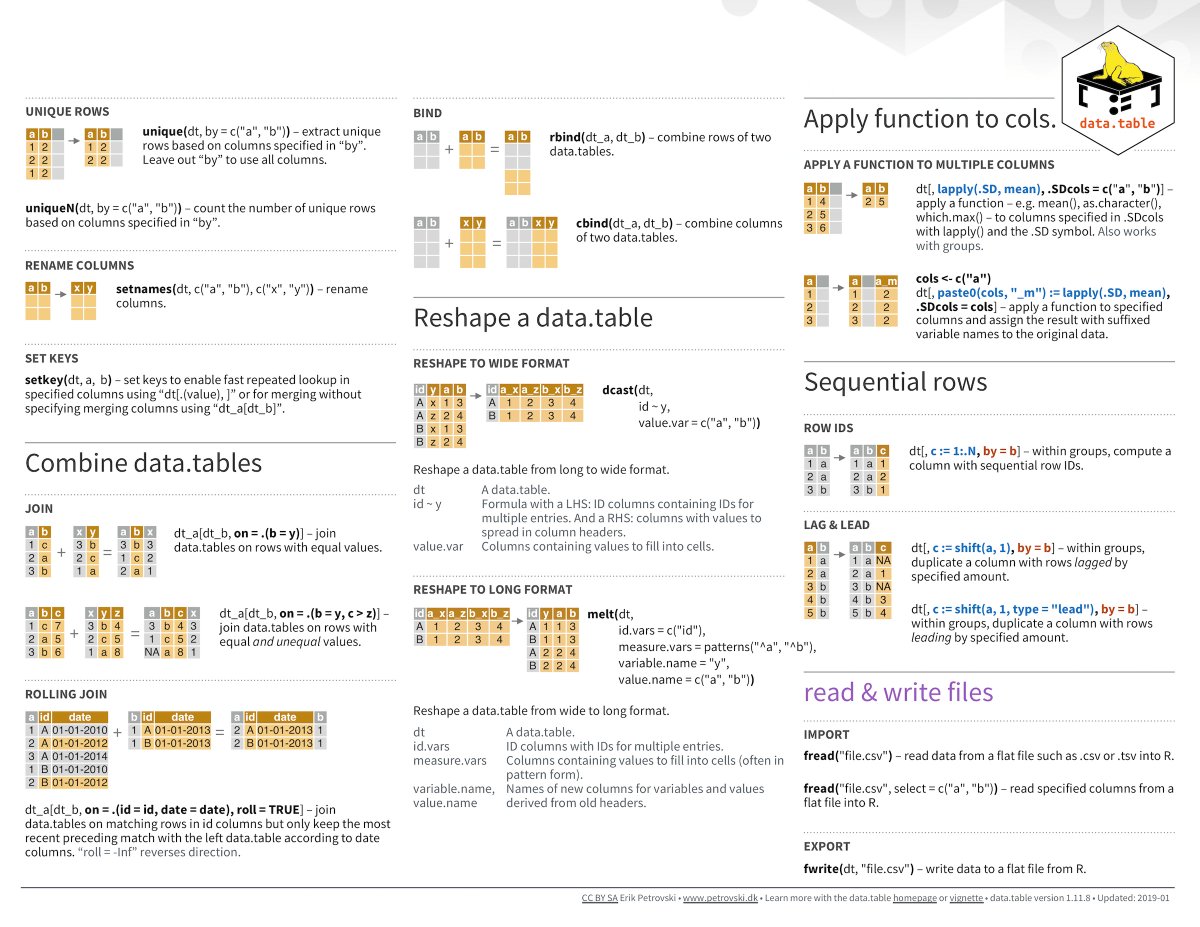
Reshape cheat sheet
Data manipulation with reshape2, My personal Reshape cheat sheet/ intro. Reshape uses the concept of the long data format which can then be reshaped, aggregated and summarized as the 'Cheat Sheets' for both IntelliJ IDEA and Visual Studio default keyboard shortcuts schemes are available on the documents section on the official site. Direct links for the latest ReSharper version: ReSharper Default Keymap: Visual Studio scheme; ReSharper Default Keymap: ReSharper 2.x / IDEA scheme

Reshape cheat sheet, Reshape cheat sheet. # Packages also contain data: ---------------- library(reshape) data(package='reshape') ?french_fries head(friench_fries) str(french_fries) Definitions of terms in reshape R package. Lets define some terms : Identifier (id) – These variables can uniquely identify a row. In the example above city name and month are the identifiers for the first table and city name, month and Variable are the identifiers for the second table.
RStudio Cheatsheets, This cheatsheet reminds you how to make factors, reorder their levels, recode Use tidyr to reshape your tables into tidy data, the data format that works the Data Transformation Reshape Data Cheat Sheet GET STRING PROPERTIES MELT DATA (WIDE → LONG) FIND MATCHING STRINGS. export delimited 'myData.csv', delimiter(',') replace. export data as a comma-delimited file (.csv) export excel'myData.xls',/* */firstrow(variables) replace. export data as an Excel file (.xls) with the variable names as the first row.
Error processing SSI fileTidymodels Cheat sheet
tidymodels . tidymodels is a meta-package that installs and load the core packages listed below that you need for modeling and machine learning.
The tidymodels package is now on CRAN. Similar to its sister package tidyverse, it can be used to install and load tidyverse packages related to modeling and analysis. Currently, it installs and attaches broom, dplyr, ggplot2, infer, purrr, recipes, rsample, tibble, and yardstick.
R Tidyverse Cheat Sheet
This tidyverse cheat sheet will guide you through the basics of the tidyverse, and 2 of its core packages: dplyr and ggplot2! The tidyverse is a powerful collection of R packages that you can use for data science. They are designed to help you to transform and visualize data. All packages within this collection share an underlying philosophy and common APIs.
Error processing SSI fileTidyverse data manipulation
A Grammar of Data Manipulation • dplyr, The package dplyr provides easy tools for the most common data manipulation tasks. It is built to work directly with data frames, with many common tasks Learn exploratory data analysis with R by watching videos and by coding.
Manipulating, analyzing and exporting data with tidyverse, In this tutorial, we're going to learn about and practice using the six core 'verbs' of data manipulation in the Tidyverse. Together, these will give you the It is an “umbrella-package” that contains several packages useful for data manipulation and visualisation which work well together such as readr, tidyr, dplyr, ggplot2, tibble, etc… Tidyverse is a recent package (launched in 2016) when compared to R base (stable version in 2000), thus you will still come across R resources that do not use tidyverse .
R Dplyr Cheat Sheet
Manipulating Data with the Tidyverse, In this article I'll explore different tools for data manipulation using tidyverse functions. This article assumes that you have a beginner's dplyr is a grammar of data manipulation, providing a consistent set of verbs that help you solve the most common data manipulation challenges: mutate () adds new variables that are functions of existing variables. select () picks variables based on their names. filter () picks cases based on their values. summarise () reduces multiple values down to a single summary.
Error processing SSI fileDatacamp working with data in the tidyverse answers
Tidyverse Cheat Sheet Pdf
Working with Data in the Tidyverse, Learn to work with data using tools from the tidyverse, and master the important skills of taming and tidying your data. Course Description. In this course, you'll learn to work with data using tools from the tidyverse in R. By data, we mean your own data, other people's data, messy data, big data, small data - any data with rows and columns that comes your way! By work, we mean doing most of the things that sound hard to do with R, and that need to happen before you can analyze or visualize your data.
R Data Wrangling Cheat Sheet
Introduction to the Tidyverse, Repository of DataCamp's 'Introduction to the Tidyverse' course. GitHub is home to over 50 million developers working together to host and review code, a real dataset of historical country data in order to answer exploratory questions. As you might know, DataCamp recently launched the Introduction to the Tidyverse course together with David Robinson, Data Scientist at Stack Overflow. Now, DataCamp has created a tidyverse cheat sheet for beginners that have already taken the course and that still want a handy one-page reference or for those who need an extra push to get
R source code for 'Modeling with Data in the Tidyverse' DataCamp , Nmegazord commented on Aug 5. Excellent work, and a fantastic course! Congratulations! Course Description. This is an introduction to the programming language R, focused on a powerful set of tools known as the Tidyverse. You'll learn the intertwined processes of data manipulation and visualization using the tools dplyr and ggplot2.
Cheat Sheet Tidyverse
Error processing SSI fileR Tidyverse Cheat Sheet Pdf
More Articles