
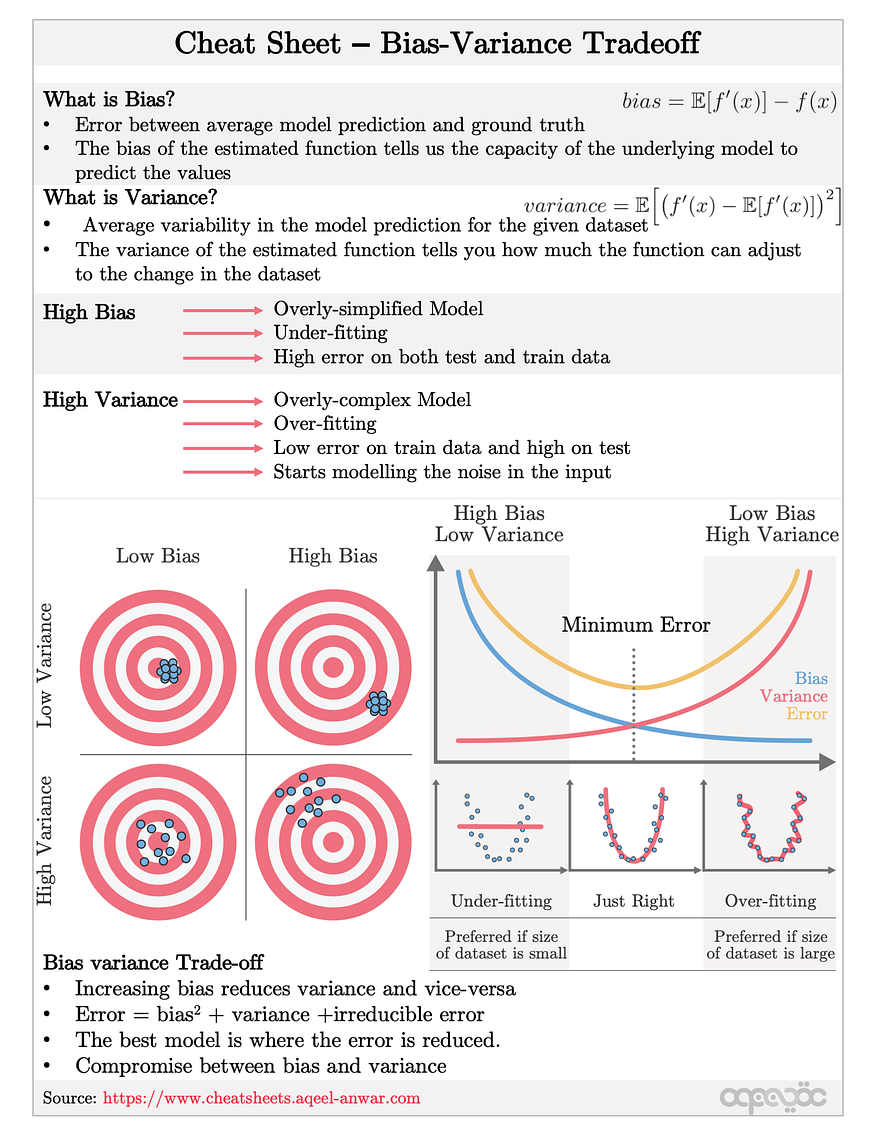
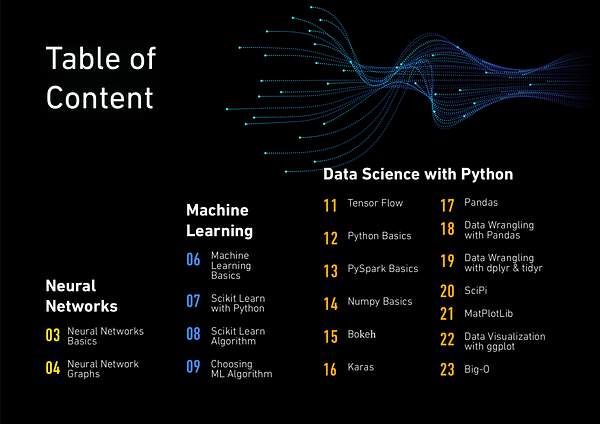
Wikipedia defines cheat sheets as a concise set of notes used for quick reference. Now the word that needs to be emphasized here is ‘quick reference’. In programming, cheat sheets are OK because no one can remember all the syntax of a programming language. Especially if the programming language. Cheat sheet for Artificial Intelligence. Download ZIP; Download TAR; View On GitHub; This project is maintained by Alexoner. Equations and corresponding derivations for Artificial Intelligence algorithms. Neural Networks Cheat Sheet Neural Networks Graphs. Graph Neural Networks (GNNs) for representation learning of graphs broadly follow a neighborhood aggregation framework, where the representation vector of a node is computed by recursively aggregating and transforming feature vectors of its neighboring nodes.
It's impossible to read about the latest or future technology (legal or otherwise) without seeing references to artificial intelligence, machine learning, deep learning, NLP or related terms. Often this is accompanied with little or no explanation, despite the field of artificial intelligence being technical and full of nuance.
As a lawyer who has written and trained machine learning models, I hope to be qualified to cut through the jargon. This is my main aim in writing this cheat sheet: to help convince you that artificial intelligence is wholly understandable without a maths or computer science degree. If, in the process, I allow you to read about artificial intelligence with a more critical eye then all the better!
This cheat sheet is set out as a glossary in a logical (rather than alphabetical) order. If you're looking for a specific term feel free to use Ctr (or Cmd) + F.
It will be released in multiple parts, with this initial part looking at classifications of AI systems. The second part examines terms relating to the training of AI systems. If you can't find what you're looking for, please let me know in the comments and I'll make sure to include it in a future part.
Classifications of AI Systems
There are many different labels that are used to classify artificial intelligence systems. These may relate to the context in which the system is used, how the system works, how it learns (if it does learn) and what kind of data it learns from. The most important point to remember in the classification of AI systems is that the classification labels are often not mutually exclusive. This is neatly illustrated for three of the terms by the diagram below.
Artificial Intelligence (or AI)-This is the most general term in the field, referring to all software systems that imitate intelligent human behaviour. This doesn't require any ability to learn: the system can be preconfigured by an expert human to react in a certain way given certain inputs. That said, most modern systems claiming to have AI capabilities do involve a level of learning, which brings us nicely to our next term. Elexim driver download for windows 10.
Machine Learning (or ML) - This refers to the subset of AI systems that are capable of learning. By learning, we mean that the system can be provided with a training dataset (or environment) and it will configure its own complex rules to imitate human behaviour. The advantage in doing so is that the system is able to make more complex rules than a human would be able to (or rather, willing to, given a reasonable amount of time and resources). There are a variety of ways that a system can learn, but we should probably begin with the current darling of the AI community.
Deep Learning (or DL) - This is one type of machine learning system that is currently the focus of increasing research and investment. Books can be (and are) dedicated to how this type of machine learning system works. For our purposes, it is enough to understand that a deep learning system puts large numbers of inputs through several layers of transformations to produce the desired output. There are quite a few results of doing so: (i) these systems require significant computing power, particular in the form of graphics processors (GPUs), (ii) as you add more layers, the numbers you are working with become more abstract so they are no longer easily understood by humans (this is the black box problem, explained in more detail below) and (iii) the same complexity makes these systems potentially very powerful.
Reinforcement Learning - This is a machine learning system that is trained by giving it an environment to run simulations, rather than an initial dataset. This allows the system to create its own data by interacting with the environment. The advantage of doing so is that the system can create more data than may already be available. Many of the latest advances in artificial intelligence that have caught the attention of the mainstream media use this type of system (for example, the Google AI that has mastered the game of Go). Reinforcement learning is agnostic to the type of machine learning model you use, though the latest advances have been with a combination of deep learning and other models.
Natural Language Processing (or NLP) - This term encompasses a variety of tasks that machine learning systems are given, all related to understanding or producing written or spoken language. You are likely to come across NLP systems day-to-day when you use your smartphone and online services (e.g. in spam filters, text prediction, voice recognition, and optical character recognition). Many of the most successful applications of AI in the legal industry are also in the field of NLP (e.g. eDiscovery). A variety of different types of machine learning models can be used in NLP but, as with other areas, a lot of the recent breakthroughs have used deep learning and transfer learning to some degree.
Supervised Learning - This refers to the input data that is used to train a machine learning system. In supervised learning, the input data is labelled. This means that the desired output for the training data is provided for the system to learn from. The process of finding or producing appropriate labelled data is one of the major challenges for a machine learning system in production. In fact, as a lot of the latest machine learning algorithms and developments are open source or published academically (even those coming out of the powerhouses in Silicon Valley, such as Google and Facebook), the availability of good training data can be the biggest differentiator between machine learning systems.
Unsupervised Learning - Unsurprisingly, this label is applied to a system that is not provided with labelled data. These systems find patterns in the data that is provided, which can then be used for classification, compression or in another way. For example, you could set a machine learning system a task of predicting the input data from the input data, but in the middle of the algorithm you create a data bottleneck that means that some of the original data must be compressed or discarded. This is known as an auto-encoder, and the resulting system can be very useful for data compression, noise reduction and to assist supervised learning systems. Speaking of which..
Semi-supervised Learning - This is where an unsupervised learning system is used in conjunction with a supervised learning system. A semi-supervised learning system will take the patterns that are found from running unsupervised learning on a large dataset, and use them in supervised learning on a smaller labelled dataset. This approach is taken to avoid the time and expense of labelling a large amount of data, while still achieving acceptable accuracy in the final machine learning system.
Gn hearing a/s driver. ** The second part of this article is available here and explains terms related to the process of training an AI system **
** If you couldn't find what you're looking for above, please let me know in the comments and I'll make sure to include it in a future part. **

There’s no doubt that Amazon Alexa has a lot of skills—more than 10,000, to be precise [Update: As of September 2018 it has grown to 50,000.] But how can you sort through the massive library of Alexa skills to find the ones that are actually useful?
[Update: We recently found a list of 3 Alexa Skills for emergency but non-life-threatening situations you might want to check out.]
Most users repeat a few standard skills frequently: asking about the weather, playing music, setting timers, and adding to your shopping list are a few common Alexa commands that are easy to remember. Elprotronic usb devices driver. Beyond these skills, it can be difficult to remember what else is available. You can’t exactly sit down and memorize all 10,000 skills.
Print Out the Best Amazon Alexa Commands and Put it by Your Device
Instead of only using a handful of commands, or fumbling through Alexa saying “hmm, I’m not sure what you mean by that,” why not keep a helpful list handy? The folks over at Smart Home Solver put together a printable-sized infographic with 100 helpful Alexa skills.
BONUS CONTENT: What Do Different Colors Mean on the Light Ring of your Amazon Echo Device?
The infographic is categorized for quick reference. Whether you ask for movie showtimes, kitchen conversions, white noise for nap time, or upcoming events in your town, there are plenty of skills that can make life easier and help you get the most out of your Alexa device. There is even a kids’ section for entertaining your little ones.
Of course, this isn’t a complete list. A few of my favorite skills not listed are productivity skills like scheduling appointments and sending emails. I would also add messaging tasks to the list, since you can use Amazon Alexa to text your contacts.
What skills would you add that are missing from the list? Let me know in the comments below!
Artificial Intelligence Cheat Sheet Pdf
And now, without further ado, here’s your very own copy of 100 Best Alexa Skills (voice commands) to print out and paste in a convenient spot near your echo device.

There’s plenty more where that came from, so stay tuned for more nuggets like this one. A big thanks to Smart Home Solver for their contribution!
[Update: We’ve just come across a cool new skill from DiscountContacts.com that’s the first of its kind. If you’re already a customer, simply install and enable the skill, and say “Alexa, reorder my contacts with Discount Contacts” and you’ll get a 10% voice order discount on your purchase. No more worrying about your next order when putting on your last pair in the bedroom or bathroom. Learn more.]
You can now order from a list of tens of thousands of items from Amazon’s Prime Now two-hour delivery service through Amazon Alexa, as well as beer, wine and spirits in select cities. Learn how.
Artificial Intelligence Cheat Sheet
Thanks for reading our work! Please bookmark 1redDrop.comto keep tabs on the hottest, most happening tech and business news from around the world. On Apple News, please favorite the 1redDrop channel to get us in your news feed.